
Demand with direction.
Clear expectations and predictable volumes can strengthen the business case for cleaner freight services.
GREEN FREIGHT PROCUREMENT
Freight buyers have the power to help create demand for cleaner transport. By working with operators and partners, they can turn purchasing decisions into a catalyst for electric freight and a fairer transition.
Buying freight is more than a transaction.
PEOPLE · POLICY · PROGRESS
01 WHY PROCUREMENT MATTERS
Every shipment is part of a bigger system. The way freight is purchased can help shape what that system becomes.
When buyers ask for credible emissions data, include environmental performance in tenders and work with transport providers on practical solutions, they send a clearer signal that cleaner freight matters.
Predictable routes, longer-term commitments and aggregated demand can give operators, financiers and infrastructure providers greater confidence to consider the investments needed for electric freight.
Clear expectations and predictable volumes can strengthen the business case for cleaner freight services.
Buyers and transporters can work with workers, energy providers, financiers and government to address shared barriers.
Consistent baselines and reporting can make performance visible and help turn ambition into practical decisions.
02 A PRACTICAL FRAMEWORK
The supplied framework is for East African shippers. Its principles can inform local conversations across Africa, adapted to each market and its freight needs.
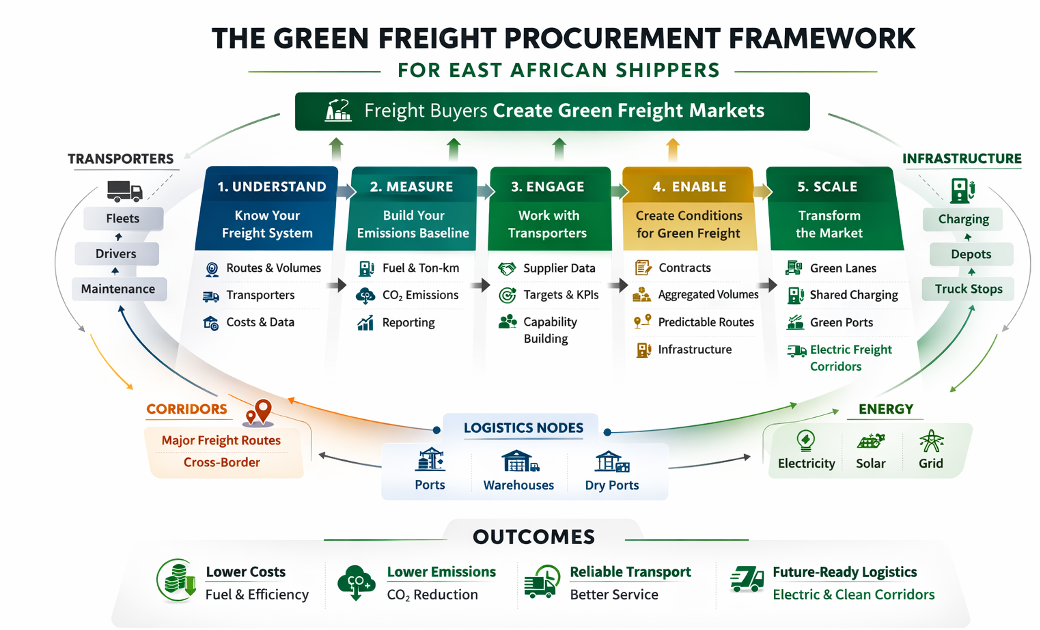
KNOW YOUR FREIGHT SYSTEM
Map routes, volumes, transport providers, vehicles, costs and the operational realities behind every shipment.
BUILD A BASELINE
Gather fuel and energy use, distance and tonne-kilometre data. Estimate emissions using a consistent method and make the scope and assumptions clear.
WORK WITH TRANSPORTERS
Bring operators and drivers into the conversation. Share data, agree practical targets and performance measures, and identify skills and capacity needs.
CREATE THE CONDITIONS
Use contracts, aggregated volumes and predictable routes to support planning. Engage energy and finance partners on charging, depots, grid access and investment.
TRANSFORM THE MARKET
Build on measured experience to explore green lanes, shared charging, greener ports and electric freight corridors suited to local conditions.
Outcomes depend on routes, vehicle use, energy supply, infrastructure and implementation. A credible transition measures progress rather than assuming results.
03 A SHARED VISION FOR SOUTH AFRICA
EVITAL Fund endorses a shared vision for a safer, smarter, lower-carbon, more competitive and inclusive road freight system for South Africa.
Turning that vision into action calls for freight buyers and operators, drivers and workers, government, financiers, energy and infrastructure partners, civil society and communities to work together.
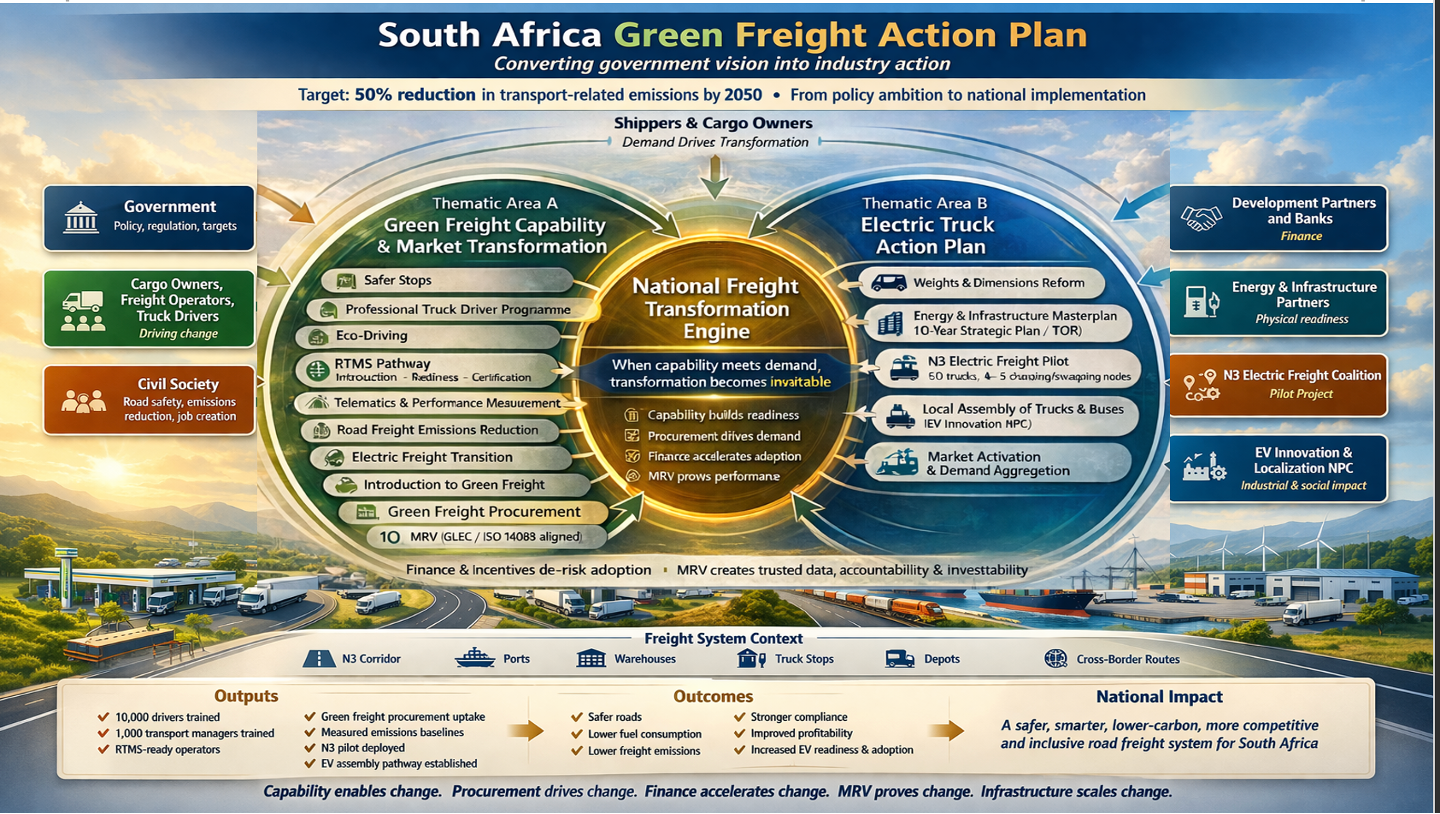
The diagram sets out a shared vision and intended actions, rather than reporting completed results. Its 50% emissions-reduction ambition is distinct from the 5% reduction by 2050 stated in South Africa’s 2018 Green Transport Strategy. Read the strategy ↗
Capability and market transformation: The vision combines safer stops, professional truck-driver programmes, eco-driving, road-freight performance and emissions measurement, green freight procurement and workforce readiness. The diagram identifies training objectives of 10,000 drivers and 1,000 transport managers.
Electric truck action: It brings together weights and dimensions reform, energy and infrastructure planning, local assembly, market activation and aggregated demand. The illustrated N3 pilot envisages 50 electric trucks and four to five charging or battery-swapping nodes.
Working together: Freight buyers, cargo owners, operators, drivers, government, civil society, finance and energy partners all have a role. The diagram connects procurement, finance, measurement and infrastructure across corridors, ports, warehouses, truck stops and depots.
PATHWAY A
PATHWAY B
Capability enables change. Procurement helps drive demand. Finance, evidence and infrastructure help turn ambition into action.
04 MOVING FORWARD TOGETHER
A just transition depends on the people who buy, move, power and shape freight having a meaningful voice.
Use procurement to set clear expectations, share demand and engage transport providers.
Bring operational experience, skills and practical insights into the design of solutions.
Help shape enabling policy, safer roads and a transition that reflects local priorities.
Work on charging, power, investment and the conditions for freight electrification.
EVITAL’S ROLE
We bring perspectives together, advocate for enabling policy and support the innovation, training and local opportunity needed to move from shared vision to practical progress.